
LA3JJ Antennas
Magnetic Loops I
I have been so lucky as to have trees all around me. I love the trees and like to talk
to them and will always ask their permission to cut some branches or to put up some
antennas.
So the reason for me to go into mag loop design was purely technical, I wanted to
make some nice things. Better looking to my eyes than the wires high up in the
treetops. My nearest and dearest may see this differently, and my stealth wire
antennas are more appreciated, if that word can be used in this connection.
My first loop was made out of a 4.5m 16mm copper tube, and by means of a suitable
PET (Polyethylene) bottle and two coca cola cans I was able to tune it up to run on
40 and 60m. It was not a design feasible for outdoor life as can be clearly seen from
the pictures below. It has been set up in my loft and does a reasonably good job
tuned to 60m. Afterwards it has occurred to me that the dimension of the loop is
much too small for 60m.
I have been so lucky as to have trees all around me. I love the trees and like to talk
to them and will always ask their permission to cut some branches or to put up some
antennas.
So the reason for me to go into mag loop design was purely technical, I wanted to
make some nice things. Better looking to my eyes than the wires high up in the
treetops. My nearest and dearest may see this differently, and my stealth wire
antennas are more appreciated, if that word can be used in this connection.
My first loop was made out of a 4.5m 16mm copper tube, and by means of a suitable
PET (Polyethylene) bottle and two coca cola cans I was able to tune it up to run on
40 and 60m. It was not a design feasible for outdoor life as can be clearly seen from
the pictures below. It has been set up in my loft and does a reasonably good job
tuned to 60m. Afterwards it has occurred to me that the dimension of the loop is
much too small for 60m.
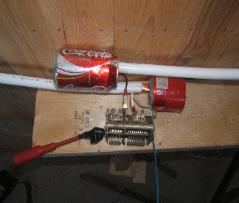
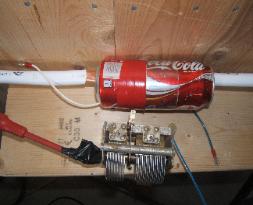
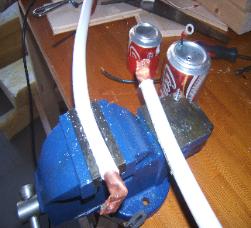
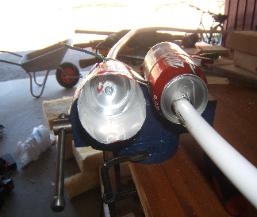
Not a very beautiful thing, but it worked.
Then I heard from Ross VK1UN / T61AA / EX1UN about a wonderful new material
called PEX-AL.
The PEX-Al tubes are used for floor heating systems. It has one outer layer of PEX -
Polyethylene, then a layer of aluminium and finally the inner PEX layer.
Ross had done a lot of successful experiments with mag loops from these tubes, I
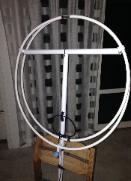
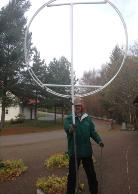
Here are some pictures to give an idea of how to make an all weather proof loop that
is adjustable.
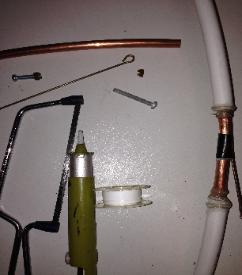
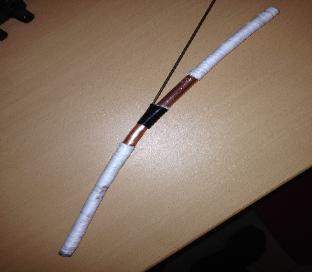
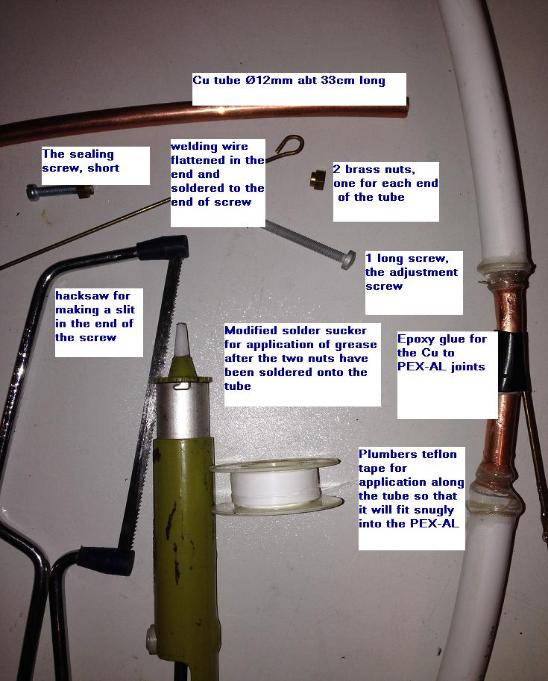
This antenna was made for the 12 m band (24.926 Mhz) and the diameter of
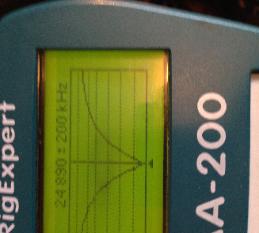
the loop is 88 cm. Measured the SWR 2:1 bandwith = 108 kHz.
I then used
the loop is 88 cm. Measured the SWR 2:1 bandwith = 108 kHz.
I then used
I used the following values:
circumference = 2.75m
conductor diam = 1.5 cm
frequency was the WSPR
band = 24.926 MHz
circumference = 2.75m
conductor diam = 1.5 cm
frequency was the WSPR
band = 24.926 MHz
I was amazed by the result of the calculation:
Antenna efficiency: 87% (-0.6 dB below 100%)
Antenna bandwidth: 107 kHz
Tuning Capacitance: 24 pF
Capacitor voltage: 787 volts RMS
Resonant circulating current: 2.97 A
Radiation resistance: 0.492 ohms
Loss Resistance: 0.076 ohms
Inductance: 1.69 microhenrys
Inductive Reactance: 265 ohms
Quality Factor (Q): 233
Distributed capacity: 7 pF
Antenna efficiency: 87% (-0.6 dB below 100%)
Antenna bandwidth: 107 kHz
Tuning Capacitance: 24 pF
Capacitor voltage: 787 volts RMS
Resonant circulating current: 2.97 A
Radiation resistance: 0.492 ohms
Loss Resistance: 0.076 ohms
Inductance: 1.69 microhenrys
Inductive Reactance: 265 ohms
Quality Factor (Q): 233
Distributed capacity: 7 pF
Did you know that the plastic material PET that is used
in most soft drink bottles today is nearly the same as
Mylar, The expensive material used for high voltage
capacitors 50 years ago?
in most soft drink bottles today is nearly the same as
Mylar, The expensive material used for high voltage
capacitors 50 years ago?
Magnetic loops II
 |
 |
 |
 |
 |